How HVAC Marketing Works in 2026 With a 3-Level Lead Generation System
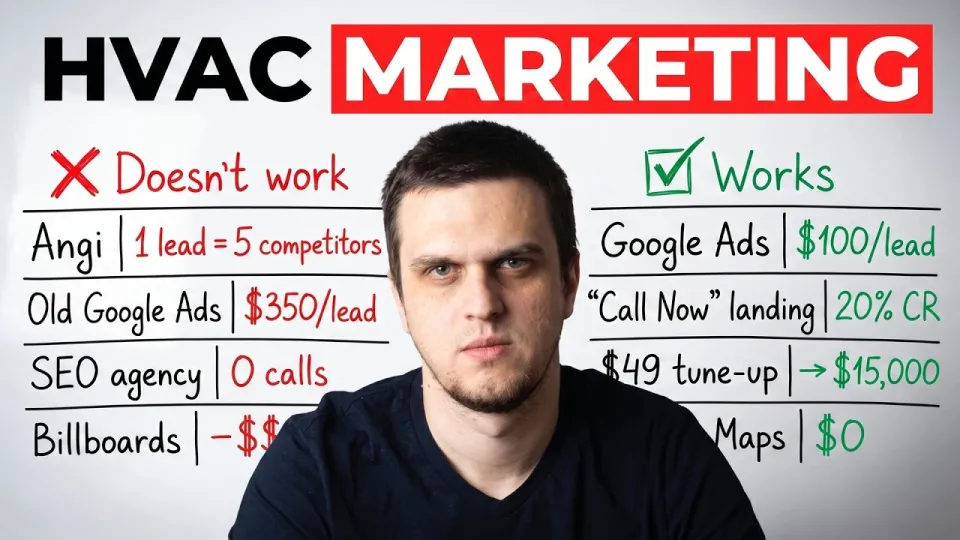
Video: HVAC Marketing 2026: The 3-Level Lead Gen System
· based on the channel Google Ads | Alex Grin
HVAC marketing is the practice of buying and earning calls from homeowners who need heating, cooling or air quality work right now, and it works best as a three-level system: paid emergency demand, slow-season offers, and free local visibility. In 2026 the winning structure is Google Ads plus Local Services Ads for urgent jobs, a low-ticket tune-up offer for the shoulder months, and Google Maps, reviews, yard signs and referral partners for leads that cost nothing per click. You can see the full breakdown in the video from Google Ads | Alex Grin and book a one-on-one strategy call through the HVAC strategy page.
Why most HVAC advertising budgets leak money
Most HVAC companies do not have a lead problem, they have a priority problem: money goes to channels that produce leads nobody owns, and nothing goes to the searches that produce the highest-value jobs. Shared-lead marketplaces sell the same homeowner to several contractors, so the company that calls first wins and everyone else pays for a conversation that never happens. Long SEO retainers often deliver traffic and rankings without a single ringing phone, because a page that ranks for "air conditioning" does not automatically answer an emergency search at 9 pm in July.
The fix is not a bigger budget, it is a different order of operations. Paid emergency demand comes first because the intent is already there; slow-season offers come second because they fill the calendar when nobody is desperate; free local visibility comes third because it compounds and lowers blended cost per lead over time. Anything that does not fit those three buckets is a candidate for elimination, at least until the business is large enough to absorb the waste.
Level 1: HVAC Google Ads and Local Services Ads for emergency calls
Level 1 is about capturing homeowners who need a repair today, and it is the only level where speed of response matters more than price. Emergency intent shows up in searches for no cooling, no heat, AC not working, furnace making noise or emergency HVAC repair, and those clicks convert at rates that generic keywords never reach. Local Services Ads sit above the standard results and are pay-per-lead rather than pay-per-click, which makes them a natural first stop for companies that want to test demand before scaling a full account.
Practical setup steps for this level:
- Separate emergency campaigns from everything else, with their own budget and their own ad copy.
- Use call-only and call-focused assets, because an emergency search almost always ends in a phone call.
- Send traffic to a page built around one action, not a full website menu.
- Track every call, including the ones that do not book, so you know which keywords produce revenue.
- Keep response time under a minute during peak hours, since the first contractor to answer usually wins the job.
The case study behind this structure comes from an HVAC Google Ads account serving Newport Beach and Irvine, where cost per lead fell from $350 to $100 while landing page conversion rate rose from 7-8% to more than 20%. The lever was not a clever bidding trick, it was the landing page: a single-button layout that removes navigation, restates the emergency, shows proof and asks for one thing. When the page stops competing with itself, the same traffic produces two to three times the leads, and the effective cost per booked job drops with it.
Level 2: slow-season HVAC ads and the $49 tune-up offer
Level 2 exists because emergency demand is seasonal and expensive to chase in the off months, so the goal shifts from urgency to affordability. A $49 AC tune-up is the classic entry offer: it is cheap enough to be an easy yes, it puts a technician inside the home, and it creates a documented list of repairs, efficiency problems and age-related risks. Marketing for HVAC companies in the shoulder season should be judged on how many of those visits turn into quoted work, not on how many clicks the campaign bought.
The economics are what make this level worth running. A homeowner who pays $49 for a tune-up and then hears that the system is 14 years old, low on refrigerant and facing a compressor replacement is a warm conversation for a $15,000 system replacement, and that conversation did not start with a $350 emergency click. The same visit also produces filter changes, capacitor replacements, duct sealing and maintenance plan sign-ups, which is why the offer can break even on the first appointment and still be profitable by the end of the season. The key is to keep the offer honest, book the visit quickly and train technicians to present findings rather than push a single outcome.
Level 3: free HVAC leads from Google Maps, reviews and referrals
Level 3 is the part of the system that does not charge per click, and it is built on local visibility rather than ad spend. A complete Google Business Profile with accurate service areas, categories, hours, photos and a steady flow of new reviews is the single strongest free asset an HVAC contractor can own, because it appears in the map pack for exactly the searches Level 1 is paying for. Reviews are the ranking fuel and the conversion fuel at the same time: homeowners read them before they call, and a profile with 200 recent reviews will out-earn a competitor with a better website and 20 old ones.
Offline tactics belong in the same bucket. Yard signs at every completed job turn a driveway into a local billboard and generate calls from neighbors who watched the truck park. Referral partners such as realtors, property managers, home inspectors, plumbers and electricians send work that arrives pre-qualified, and a simple, reliable referral habit beats a complicated affiliate program. The rule for this level is consistency over volume: one new review request per job, one sign per install, one partner conversation per week.
What to skip until the business reaches $10M
Some channels are not wrong, they are just early, and paying for them before the three levels are working is the most common way HVAC marketing budgets get wasted. Shared-lead marketplaces, broad brand-awareness campaigns, expensive website redesigns and long SEO contracts that are not tied to call volume all fall into that category for a company that still needs more booked jobs this month. The test is simple: if a channel cannot be traced to a call, a booked appointment or a signed estimate within a reasonable window, it belongs on the later list.
A more useful allocation for most contractors is to fund Level 1 until cost per lead and conversion rate are stable, add Level 2 to smooth the season, and run Level 3 continuously because it costs time rather than money. Once the company is large enough that a few wasted dollars do not change the month, the broader channels can be tested properly, with real tracking and real benchmarks.
Common questions and doubts from contractors
Contractors evaluating this system usually raise the same three concerns: whether paid search is worth it when leads are also available from directories, whether a $49 offer attracts only bargain hunters, and how long free channels take to produce calls. The short answers are that owned leads cost more per unit but far less per booked job, that a tune-up offer filters by willingness to book rather than by income, and that map visibility typically takes weeks of consistent review activity rather than months of waiting. The other recurring question is tracking: without call recording or at least call attribution, every one of these decisions is guesswork, so measurement comes before scaling.
Conclusion
HVAC marketing in 2026 rewards structure over spend, and the three-level system gives that structure a clear order: paid emergency demand first, slow-season offers second, free local visibility always running in the background. The Newport Beach and Irvine account shows what the first level can do when the landing page is built for one action, cutting cost per lead from $350 to $100 and pushing conversion above 20%. The rest of the system is what keeps the calendar full when the weather stops cooperating and what lowers blended cost per lead over a full year. This breakdown comes from the Google Ads | Alex Grin channel, which covers exactly this kind of account-level detail for home service businesses. If you want help applying it to your own market, book a one-on-one strategy call at https://alex-grin.com/hvac?utm_source=youtube&utm_medium=social&utm_campaign=hvac&utm_content=comment.
Key takeaways
- Level 1 runs Google Ads plus Local Services Ads on emergency searches, where the intent and the job value are highest.
- A Newport Beach and Irvine HVAC account cut cost per lead from $350 to $100 and lifted landing page conversion from 7-8% to over 20%.
- Level 2 targets the slow season with a $49 AC tune-up offer that later converts into a $15,000 system replacement.
- Level 3 is free lead flow: Google Maps visibility, reviews, yard signs and referral partners.
- Paid directories and long SEO contracts are usually skipped until a company approaches $10M in revenue.
Source: HVAC Marketing 2026: The 3-Level Lead Gen System · Markdown version
Questions & answers
Is Google Ads worth it for HVAC companies if shared-lead platforms already deliver leads?
Owned campaigns usually cost more per lead than a shared marketplace, but far less per booked job, because the lead is not resold to three competitors. The Newport Beach and Irvine account in the breakdown cut cost per lead from $350 to $100, which changes the math entirely. The trade-off is that you must manage the account, the landing page and the call response yourself.
Does a $49 AC tune-up offer attract only price shoppers?
It attracts homeowners willing to book an appointment, which is the behavior that matters, and the technician visit creates the opportunity to quote repairs or a replacement. In the case described, a $49 tune-up can lead to a $15,000 system replacement when the findings are presented honestly. The offer should be treated as a door opener, not as the product.
How long does it take to get free HVAC leads from Google Maps and reviews?
Map pack visibility is not instant, but it responds to consistent activity rather than to a long waiting period. A complete Google Business Profile plus a steady stream of new reviews, yard signs and referral partners typically starts producing calls within weeks of consistent effort. The advantage is that these leads keep arriving without a per-click cost.
What should an HVAC company stop paying for first?
Anything that cannot be traced to a call, a booked appointment or a signed estimate should be paused before cutting the channels that produce jobs. Shared-lead subscriptions, untracked SEO retainers and brand campaigns are the usual first candidates. Paid emergency search, slow-season offers and free local visibility should be funded and measured first.